Exit BeagleBone Black, hello Cubieboard2!

Put up my BeagleBone Black for sale. It was gathering dust, somehow this board doesn’t appeal to me. Biggest drawback is that it seems to be very picky with power adapters. If you don’t use a linear power adapter USB devices might not work properly. And that was exactly the issue I was facing, I just couldn’t get my USB audio interfaces to work on the BBB. So I lost interest because well, that’s what I bought the device for, to get sound out of it with the help of an USB audio interface. Add to this that there is no realtime kernel or RT patchset available for the BBB and that the BBB is quite a complex little device (it’s actually a REAL dev board). It would’ve cost me too much time to completely fathom it. No bad feelings though, the BBB is a very nice product and it sure has the slickest looks of all ARM SoC dev boards around.

Also I got a Cubieboard2 in recently. And that board has absorbed me for the last week and a half. It’s quite easy to set up (not as easy as the RPi though), has a lot of IO (yes, it has audio in and out!) and it blows both the RPi and BBB away when it comes to performance with its dual core A20 Allwinner SoC that can easily be overclocked to 1.2 GHz. Alas, no realtime kernel or RT patchset either but hey, I managed to get a RT kernel running on a Rockchip RK3066 based device so I could at least give it a try. And it worked out well. I’m now running a 3.4.61-rt77 kernel on it with a custom Debian Wheezy installation. This time I used git to keep track of the modifications I made so it was a lot easier to create a usable diff. I also patched the driver for the onboard audio codec because the hardcoded defaults were just unusable for realtime audio. Minimum number of periods was 4 and minimum buffer size was 1024. Don’t ask me why. So I’ve changed these to 2 and 16 respectively and managed to get JACK running at a respectable -p64 -n2 -r44100. Fired up some JACK clients and this little monster keeps up very well. USB audio interfaces are no problem either, I can run my Edirol UA25 in Advanced mode with -p64 -n3 -r48000 without any hitch. This is probably because the Cubieboard2 doesn’t use a Synopsys DesignWare OTG controller with out-of-tree dwc_otg drivers like the RPi but a better supported USB controller. At the moment the Cubieboard2 is the nicest ARM dev board I have laid my hands on so far.
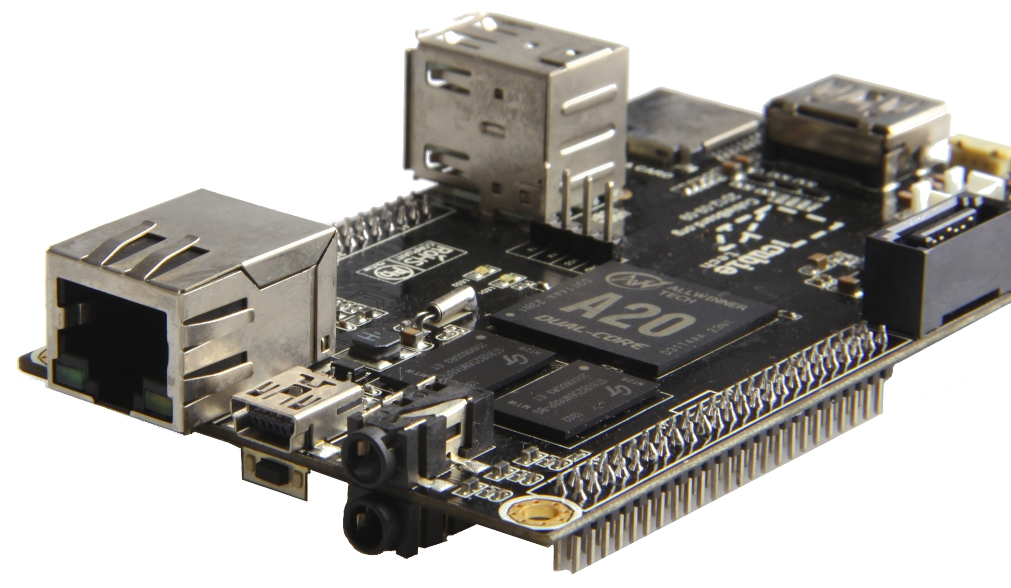

text-align: center;

Cubieboard2

RT patchset 3.4.61-rt77 for linux-sunxi, sunxi-3.4 branch

Low latency defaults patch for sunxi-codec driver

Exit BeagleBone Black, hello Cubieboard2!

Bricking the UG802 Android TV stick

Pulled out my soldering iron, soldered a reset button and a switch to boot into recovery on the PCB and connected my UG802 clone/revision to my TV. Nothing. lsusb. Crap, it boots in flash mode. Let’s try reflashing the whole bloody thing. Well that works so the NAND is not defective or anything. Reboot. Nothing, lsusb still reports the device is in flash mode. So I removed all my soldering efforts which I really regretted because it was quite nicely done given my poor soldering skills and tried again. Still nothing. Arrrggghhhh. Enjoyed a cold Warsteiner and let it rest.

Today I brought the device with me to the office. Hooked it up to a Windows machine, ran the ROM flash tool from Finless’ custom ROM package for this device and powered it up. I was greeted with the most ugly Android boot animation I had ever seen. But at least the device works again so thanks Finless!

So now I can move on again. I had Jack1 running on it so it should be possible to turn this device into a very cheap, yet powerful alternative to do real-time, low-latency audio. Compared to the Raspberry Pi JACK already consumed way less CPU (12% on the RPi compared to 2% on the RK3066 device with the same JACK settings) and I noticed the device has some more IRQ’s so if I could get all of those threaded that should give me some more flexibility to get everything working in a more stable way. I did have to disable WiFi otherwise the whole USB stack crashed after starting JACK. Also tried with an external WiFi dongle, same issue. I can even generate xruns when pressing keys on an attached keyboard. So it’d be really nice if I had serial console access to this thing. But I’ll figure that out too. And maybe the USB part of the kernel can be tweaked to improve things on the USB level.

Bricking the UG802 Android TV stick

Raspberry Pi als virtuele gitaarversterker: MIDI en effecten

Live demo van m’n Raspberry Pi, guitarix en een MIDI floorboard.

Raspberry Pi als virtuele gitaarversterker: MIDI en effecten

Eerste DX bestelling binnen

M’n MIDI to USB kabel en oprolbaar USB drumpad zijn binnen.

MIDI to USB kabel:

jeremy@piertje:~$ cat /proc/asound/cards
...
 1 [USB20MIDI      ]: USB-Audio - USB2.0-MIDI
                      USB2.0-MIDI at usb-0000:00:1d.0-1, full speed

USB drumpad werd in eerste instantie niet goed herkend:

jeremy@piertje:~$ lsusb
...
Bus 005 Device 014: ID 1941:8021 Dream Link WH1080 Weather Station / USB Missile Launcher

USB Missile Launcher? Even googlen, ah: https://bugs.launchpad.net/ubuntu/+source/usbutils/+bug/377967
Maar dan nog, ik weet toch bijna zeker dat dit ding gewoon meteen hoort te werken. Dus even checken met het drumpadje wat ik in bruikleen heb:

jeremy@piertje:~$ lsusb
...
Bus 005 Device 015: ID 0218:0001 Hangzhou Worlde

Dus er klopt iets niet helemaal, moet recht te trekken zijn. Na wat verder gegoogled te hebben kwam ik hier op uit: https://code.google.com/p/drumroll

Code gecompiled en het draait. Maar vrees dat ik de drumpad niet met mijn RPi kan gebruiken want de drumroll binary verstookt op mijn notebook al 4% aan CPU. Maar zien wat ik met de drumpad ga doen, sowieso kijken of ik er ergens een kan vinden die wel een USB MIDI device is.

Eerste DX bestelling binnen

DX

Oftewel DealExtreme. Eigenlijk een beetje herontdekt door de buurtgenoot die hier laatst op bezoek was. Hij had een oprolbaar USB drumpadje mee en dat vond ik zo’n cool ding, moest ik ook hebben. Uiteindelijk kwam ik dus uit op DealExtreme waar ik wel eerder spulletjes had besteld. Het gaat om dit drumpadje:

Niet aanslaggevoelig ofzo maar het padje stuurt wel keurig MIDI CC messages uit over MIDI kanaal 10. Ik heb zo’n idee dat dit één van de goedkoopste USB MIDI controllers is die je momenteel kunt krijgen. Ik denk dat ik ‘m ga demonteren om er een USB MIDI footswitch van te maken. Heb er gelijk een USB MIDI kabel bij besteld:

$5.99, dat kun je niet laten liggen toch? Ik ga deze gebruiken om mijn Boss FC-50 MIDI footswitch aan mijn Raspberry Pi te hangen. Ik kan namelijk de MIDI poorten op mijn Edirol UA-25 niet gebruiken aangezien deze het alleen doen als de UA-25 in Advanced mode staat en dat staat momenteel uit omdat anders JACK niet werkt op mijn RPi icm. de UA-25. Hopelijk werkt het wel met dit cheapo kabeltje. Binnenkort ga ik ook deze bestellen:

Ziet er bekend uit hè? Het is gewoon hetzelfde apparaat als de Behringer UCG102!

De UCG102 is al goedkoop (rond de €25,-) maar op DealExtreme kost dit apparaatje slechts $14.80! Samen met de USB MIDI kabel ga ik deze gebruiken met mijn RPi. Kijken of ik een cheapo customizable gitaarversterkeremulatieapparaatje kan bouwen voor minder dan €50,-.

DX

Tijden veranderen

De vraag: Linux Audio 2012: Is Linux Audio moving forward?

De antwoorden:

I’d pose a different question:

Is OSX/Win Audio moving _backward_?

If OSX continues to move towards iOS, and Win continues to move towards Metro, and Thunderbolt stalls, and screens get smaller, and expansion ports get scarcer, then Linux might become the de-facto “pro” multimedia platform simply because the other choices have become too dumbed down.

Of course _most_ users will be happy with the ease and power of the tools that will be available on iOS/Metro. And _most_ users is where the money is, so Apple/Microsoft are chasing the right users. But there will be some serious users that need a powerful production system with big screens and big peripherals, and for these users, Linux might become the standard.

Ben Loftis – Harrison Consoles

… if you’re on the “inside” of Apple audio development its clear that their focus is really shifting away from “creative/professional audio” toward “consumer audio”. i’m talking about the OS infrastructure here, not the existing apps. now, traditionally, Apple has done an amazing job of creating technology that manages to serve the needs of both audiences, and they *may* manage to carry on doing that. but there are few signs from things going on in both iOS and the latest versions of OS X that this might not carry on. personally, i’d probably put my money on apple, but there is a real question what their (infrastructure) focus is going to be in a year or two.

Paul Davis – Ardour/JACK

Elders op het web ving ik naar aanleiding van dit topic een glimpje op van deze toekomst.

Prism Sound Lyra USB audio interface

Tijden veranderen

MIDI USB Keyboard gebruiken in Ubuntu

Heb een kort video handleidinkje gemaakt hoe je in Ubuntu een MIDI USB keyboard aan een softsynth kan knopen en deze op YouTube gezet. Als screencast programma heb ik recordMyDesktop uit mijn eigen PPA gebruikt zodat ik de output van zowel mijn mic als de softsynth met recordMyDesktop kon verbinden mbv JACK. De mic output heb ik nog wel even door een lichte galm gegooid via JACK Rack anders klonk het zo droog. De video handleiding is wel in het Engels aangezien ik deze in eerste instantie naar aanleiding van een post op het Ubuntu forum had gemaakt.

MIDI USB Keyboard gebruiken in Ubuntu